AI-Assisted Spatial Layout System

AI-Assisted Spatial Layout System

AI-Assisted Spatial Layout System

AI-Assisted Spatial Layout System

AI-assisted spatial layout system for a confidential enterprise client. My role was to refine the initial idea into a workable solution and delivered the UX and UI. The project started in July 2025.

AI-assisted spatial layout system for a confidential enterprise client. My role was to refine the initial idea into a workable solution and delivered the UX and UI. The project started in July 2025.

AI-assisted spatial layout system for a confidential enterprise client. My role was to refine the initial idea into a workable solution and delivered the UX and UI. The project started in July 2025.

AI-assisted spatial layout system for a confidential enterprise client. My role was to refine the initial idea into a workable solution and delivered the UX and UI. The project started in July 2025.

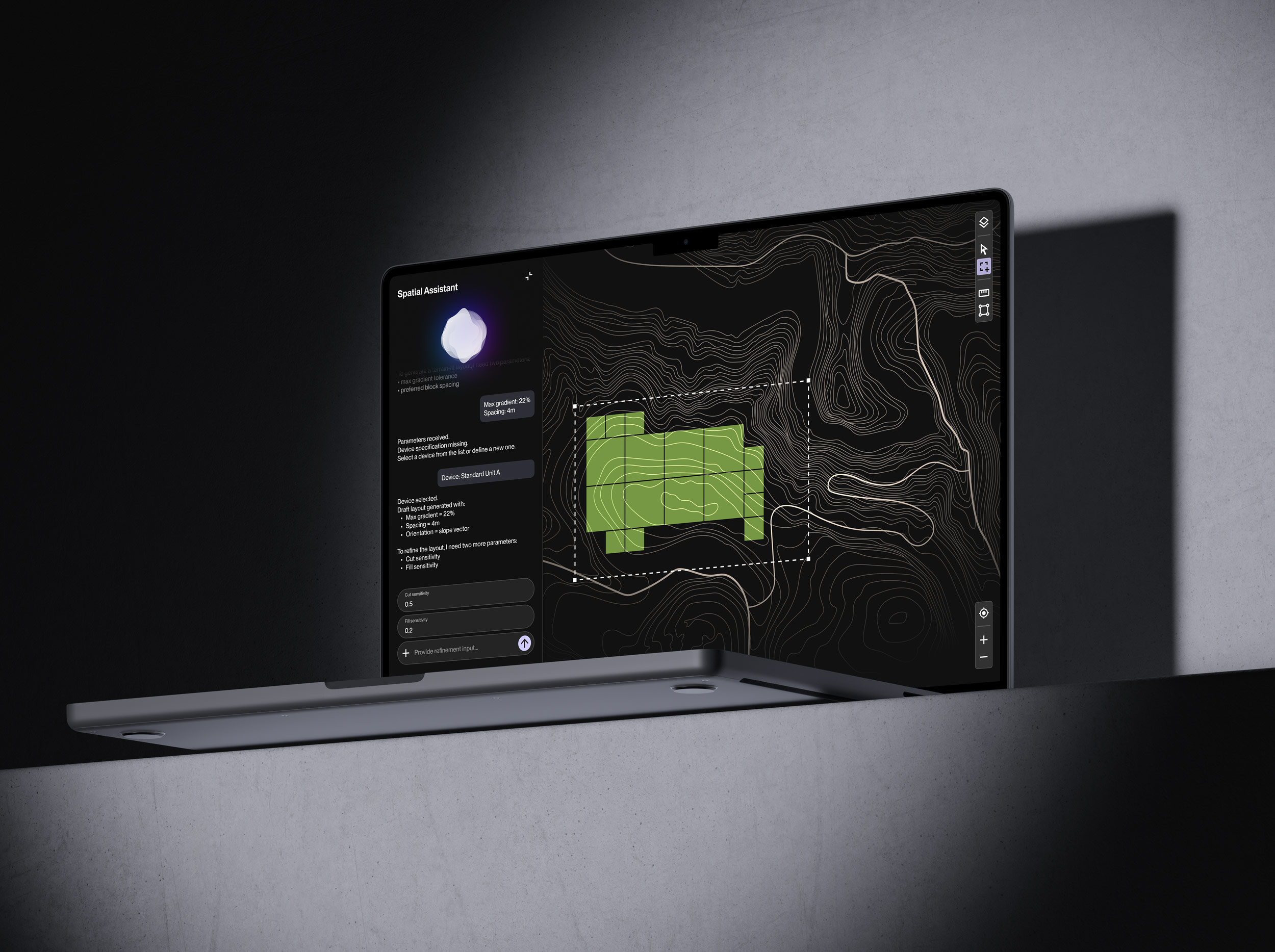
AI-assisted system for automated spatial layout generation within a GIS environment. Focus on algorithmic logic, structured inputs, and a lean human–AI workflow.

About

The project focused on developing an automated spatial layout generation system embedded within a GIS environment.

The underlying planning process involved multiple constraints, operational rules, and technical parameters. The goal was to establish a workflow that reduces manual effort, accelerates decision-making, and tightly integrates user actions, underlying data models, and algorithmic output.

Challenges

Spatial layouts are typically formed through a combination of expert knowledge, operational guidelines, and context-dependent constraints. Without systematic support, this results in high effort, inconsistent outcomes, and limited scalability.

An algorithmic component must therefore not only process input parameters but also identify incomplete conditions and request additional data when necessary.

Solutions

The solution uses an internal, domain-specific AI model acting as a dedicated layout assistant:

Drawing a region directly triggers analysis and layout generation

Drawing a region directly triggers analysis and layout generation

Drawing a region directly triggers analysis and layout generation

Drawing a region directly triggers analysis and layout generation

Drawing a region directly triggers analysis and layout generation

Drawing a region directly triggers analysis and layout generation

Drawing a region directly triggers analysis and layout generation

Missing parameters are requested in a targeted, context-aware manner

Missing parameters are requested in a targeted, context-aware manner

Missing parameters are requested in a targeted, context-aware manner

Missing parameters are requested in a targeted, context-aware manner

Missing parameters are requested in a targeted, context-aware manner

Missing parameters are requested in a targeted, context-aware manner

Missing parameters are requested in a targeted, context-aware manner

Structured parameter inputs guide the interaction

Structured parameter inputs guide the interaction

Structured parameter inputs guide the interaction

Structured parameter inputs guide the interaction

Structured parameter inputs guide the interaction

Structured parameter inputs guide the interaction

Structured parameter inputs guide the interaction

Extracted expert knowledge allows early application of domain rules, reducing the need for additional questions

Extracted expert knowledge allows early application of domain rules, reducing the need for additional questions

Extracted expert knowledge allows early application of domain rules, reducing the need for additional questions

Extracted expert knowledge allows early application of domain rules, reducing the need for additional questions

Extracted expert knowledge allows early application of domain rules, reducing the need for additional questions

Extracted expert knowledge allows early application of domain rules, reducing the need for additional questions

Extracted expert knowledge allows early application of domain rules, reducing the need for additional questions

Automation is prioritized wherever possible to streamline the planning workflow

Automation is prioritized wherever possible to streamline the planning workflow

Automation is prioritized wherever possible to streamline the planning workflow

Automation is prioritized wherever possible to streamline the planning workflow

Automation is prioritized wherever possible to streamline the planning workflow

Automation is prioritized wherever possible to streamline the planning workflow

Automation is prioritized wherever possible to streamline the planning workflow

UX Methodology & Design Process

The system was designed through a research-driven process:

In-depth interviews with end users to extract domain knowledge

In-depth interviews with end users to extract domain knowledge

In-depth interviews with end users to extract domain knowledge

In-depth interviews with end users to extract domain knowledge

In-depth interviews with end users to extract domain knowledge

In-depth interviews with end users to extract domain knowledge

In-depth interviews with end users to extract domain knowledge

Synthesis of expert rules into applicable decision logic

Synthesis of expert rules into applicable decision logic

Synthesis of expert rules into applicable decision logic

Synthesis of expert rules into applicable decision logic

Synthesis of expert rules into applicable decision logic

Synthesis of expert rules into applicable decision logic

Synthesis of expert rules into applicable decision logic

Design Thinking sessions to define interaction patterns

Design Thinking sessions to define interaction patterns

Design Thinking sessions to define interaction patterns

Design Thinking sessions to define interaction patterns

Design Thinking sessions to define interaction patterns

Design Thinking sessions to define interaction patterns

Design Thinking sessions to define interaction patterns

Iterative prototyping to scope the AI’s role and behavior

Iterative prototyping to scope the AI’s role and behavior

Iterative prototyping to scope the AI’s role and behavior

Iterative prototyping to scope the AI’s role and behavior

Iterative prototyping to scope the AI’s role and behavior

Iterative prototyping to scope the AI’s role and behavior

Iterative prototyping to scope the AI’s role and behavior

Progressive reduction of complexity through parameter grouping and automated derivations

Progressive reduction of complexity through parameter grouping and automated derivations

Progressive reduction of complexity through parameter grouping and automated derivations

Progressive reduction of complexity through parameter grouping and automated derivations

Progressive reduction of complexity through parameter grouping and automated derivations

Progressive reduction of complexity through parameter grouping and automated derivations

Progressive reduction of complexity through parameter grouping and automated derivations

Validation of the interaction model with technical stakeholders

Validation of the interaction model with technical stakeholders

Validation of the interaction model with technical stakeholders

Validation of the interaction model with technical stakeholders

Validation of the interaction model with technical stakeholders

Validation of the interaction model with technical stakeholders

Validation of the interaction model with technical stakeholders

UI Concept

The interface centers on a technical, highly structured interaction model:
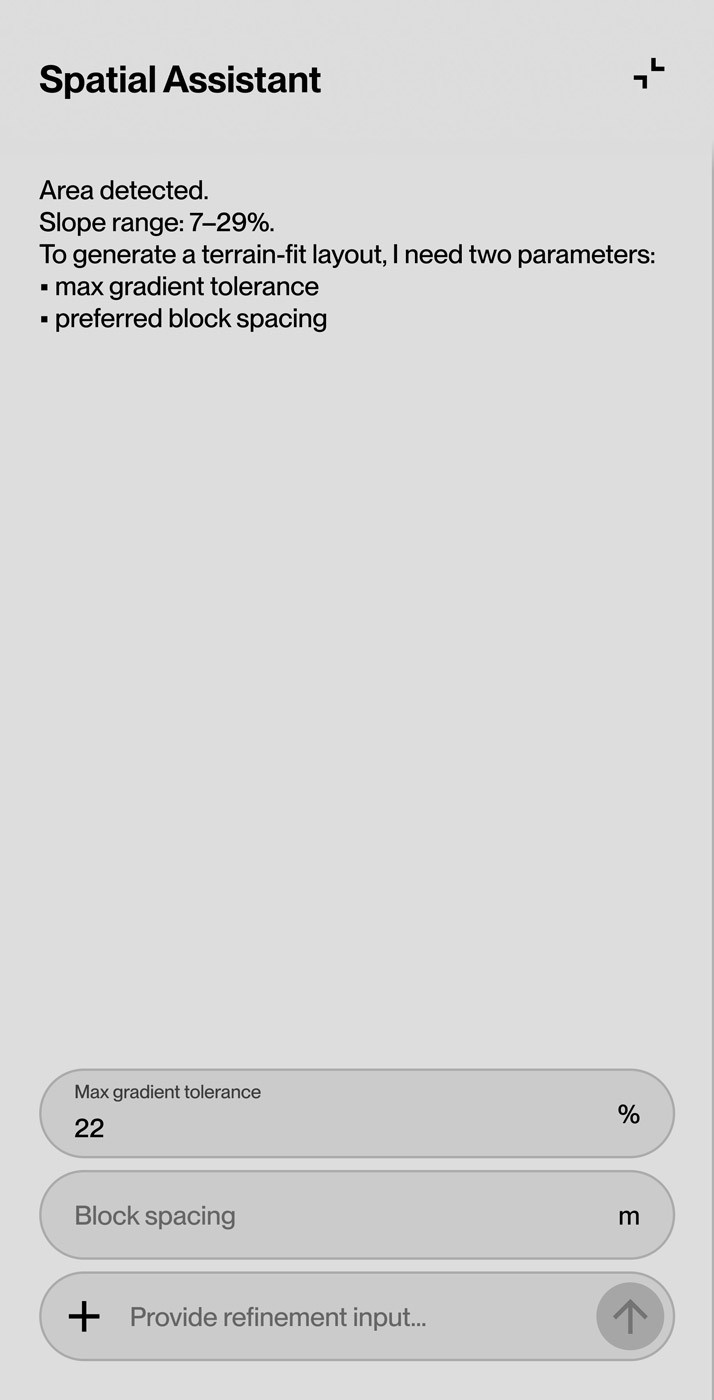
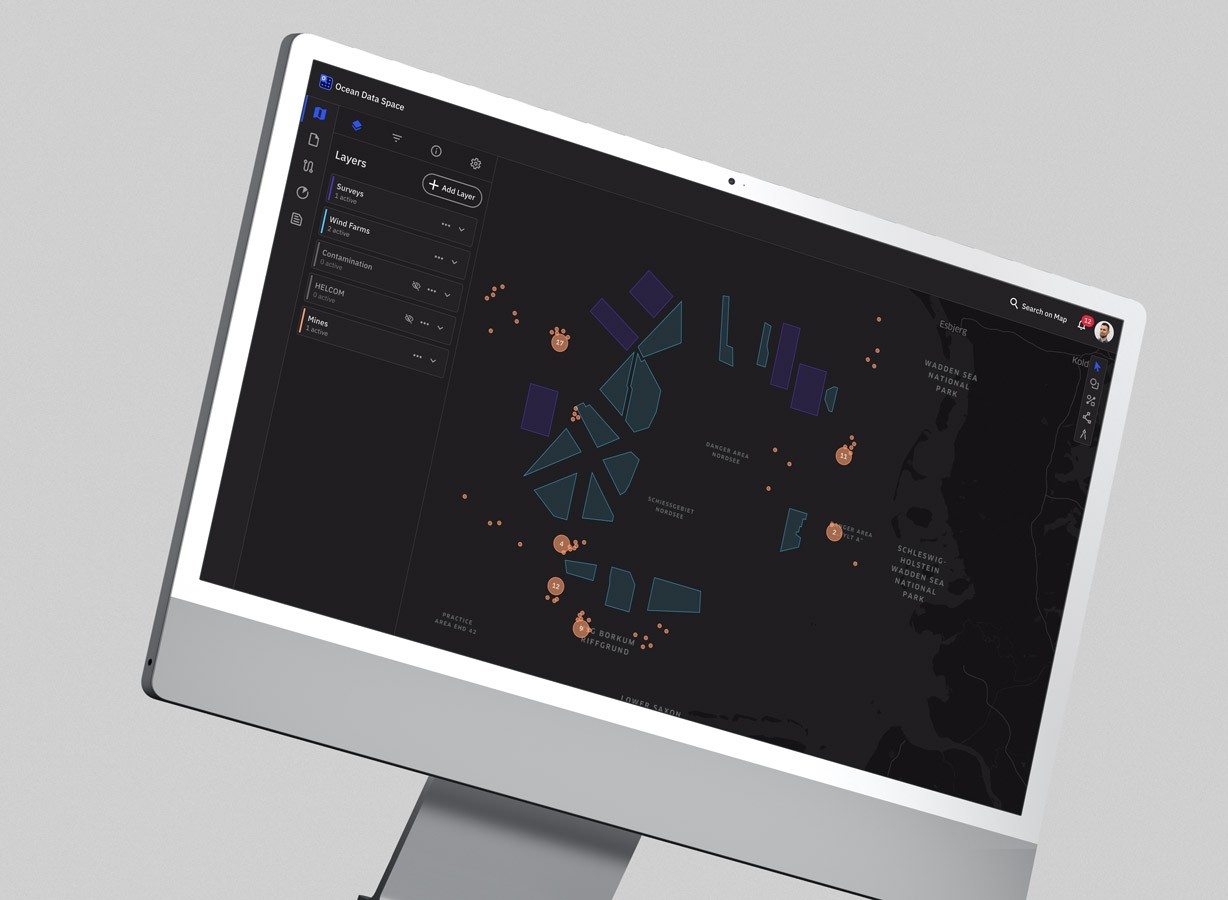
The AI activates automatically when relevant GIS actions occur

The AI activates automatically when relevant GIS actions occur

The AI activates automatically when relevant GIS actions occur

The AI activates automatically when relevant GIS actions occur

The AI activates automatically when relevant GIS actions occur

The AI activates automatically when relevant GIS actions occur

The AI activates automatically when relevant GIS actions occur

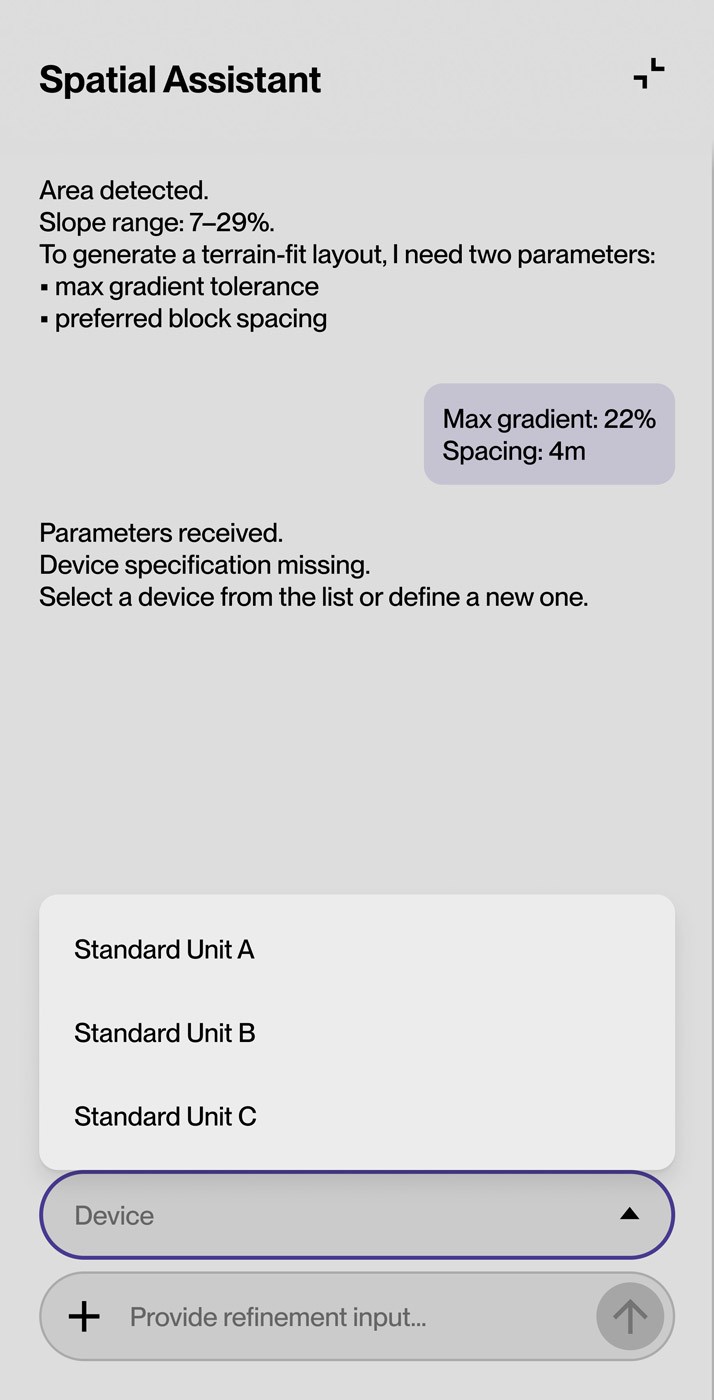
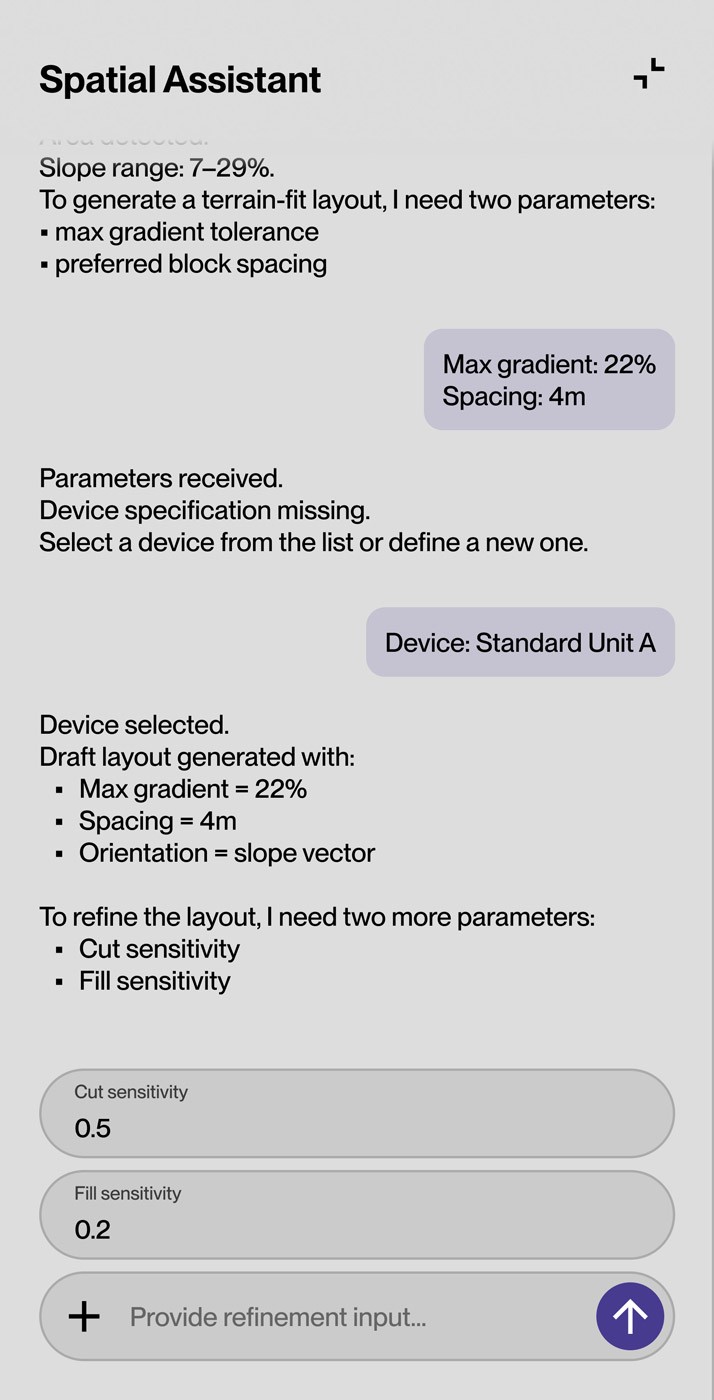
Parameter inputs are provided through explicit, well-defined input fields rather than free-form text

Parameter inputs are provided through explicit, well-defined input fields rather than free-form text

Parameter inputs are provided through explicit, well-defined input fields rather than free-form text

Parameter inputs are provided through explicit, well-defined input fields rather than free-form text

Parameter inputs are provided through explicit, well-defined input fields rather than free-form text

Parameter inputs are provided through explicit, well-defined input fields rather than free-form text

Parameter inputs are provided through explicit, well-defined input fields rather than free-form text

Select components allow choosing existing operational units or devices

Select components allow choosing existing operational units or devices

Select components allow choosing existing operational units or devices

Select components allow choosing existing operational units or devices

Select components allow choosing existing operational units or devices

Select components allow choosing existing operational units or devices

Select components allow choosing existing operational units or devices

New units can be defined by entering required attributes in predefined fields

New units can be defined by entering required attributes in predefined fields

New units can be defined by entering required attributes in predefined fields

New units can be defined by entering required attributes in predefined fields

New units can be defined by entering required attributes in predefined fields

New units can be defined by entering required attributes in predefined fields

New units can be defined by entering required attributes in predefined fields

The AI communicates through concise, technical messages focused on parameters and constraints

The AI communicates through concise, technical messages focused on parameters and constraints

The AI communicates through concise, technical messages focused on parameters and constraints

The AI communicates through concise, technical messages focused on parameters and constraints

The AI communicates through concise, technical messages focused on parameters and constraints

The AI communicates through concise, technical messages focused on parameters and constraints

The AI communicates through concise, technical messages focused on parameters and constraints

Draft layouts are visualized immediately and can be refined through additional inputs

Draft layouts are visualized immediately and can be refined through additional inputs

Draft layouts are visualized immediately and can be refined through additional inputs

Draft layouts are visualized immediately and can be refined through additional inputs

Draft layouts are visualized immediately and can be refined through additional inputs

Draft layouts are visualized immediately and can be refined through additional inputs

Draft layouts are visualized immediately and can be refined through additional inputs

AI-driven assistant prompting for structured parameters and supporting decision-making in a spatial planning workflow.

Outcome

The resulting concept supports automated spatial layout generation with clear guidance and reduced complexity. Through the integration of an internal AI assistant that detects missing values, requests only relevant parameters, and leverages expert knowledge, the system accelerates planning tasks, reduces manual input, and produces consistent and explainable results.